We (especially Javi) got up early on Thursday to make the three-subway commute to MSK by my 8:30 report time. When we arrived I realized a Kansas connection to the Koch brothers. The center is unsettling in how nice it is, while, as a chatty lady in the elevator remarked to us, it is not a nice place to have to be. The waiting room:
The night before I had filled out 15 electronic intake forms, which they initially could not find in the system. I politely (hopefully) refused to fill the forms again and it was somehow resolved. Then I was called to get blood drawn for many test tubes, par for the course. Last year I started being able to directly look at the needle going in my skin and the blood coming out, which is kind of empowering.
The administrator for Dr. Goldberg escorted us to his office and a private patient room. A colorful painting on the wall was dated 2019. First I saw a nurse who started off her questions by asking if I was interested in fertility preservation, catching me by surprise. She reviewed that and other MSK resources with me, including agnostic/atheist spiritual counseling, which I declined but intrigues me as a concept. Second I met a pharmacist who didn’t have much of a job to do with me yet. Third I saw a doctor in training with Dr. Goldberg, who reviewed my history. I noticed she was pregnant as she dove deeper into my pregnancy of unknown location saga than seemed medically necessary. We waited for Dr. Goldberg to attend to an emergency on another floor, wondering what situation it could be.
Dr. Goldberg then came in like a boss with the others minus the pharmacist. We reviewed everything again. Here are the highlights from what he said:
- My case is unusual
- I am likely headed down the path of an MPN diagnosis
- My hypereosinophilia makes it difficult to diagnose
- My platelets were little bit high on the CBC (for the first time ever) so they are not ruling out the “better” MPN called Essential Thrombocythemia (ET)
- The MSK pathologist needs to look at the BMB slides before a diagnosis is made and they don’t have the slides yet
- After more tests, I will come back in about a month and hopefully will get a diagnosis then
- They are not concerned about my spleen because it’s not much enlarged
- They are more concerned about my breathing and I will see an MSK pulmonologist
- I will get a cardiac workup and do other eosinophilia related investigations again including my favorite poop studies
- MSK will run a “sophisticated” analysis of my entire DNA / genetic sequencing which will look for other mutations
- They will compare the results to my DNA sequence from when I was born, for which the next step was:
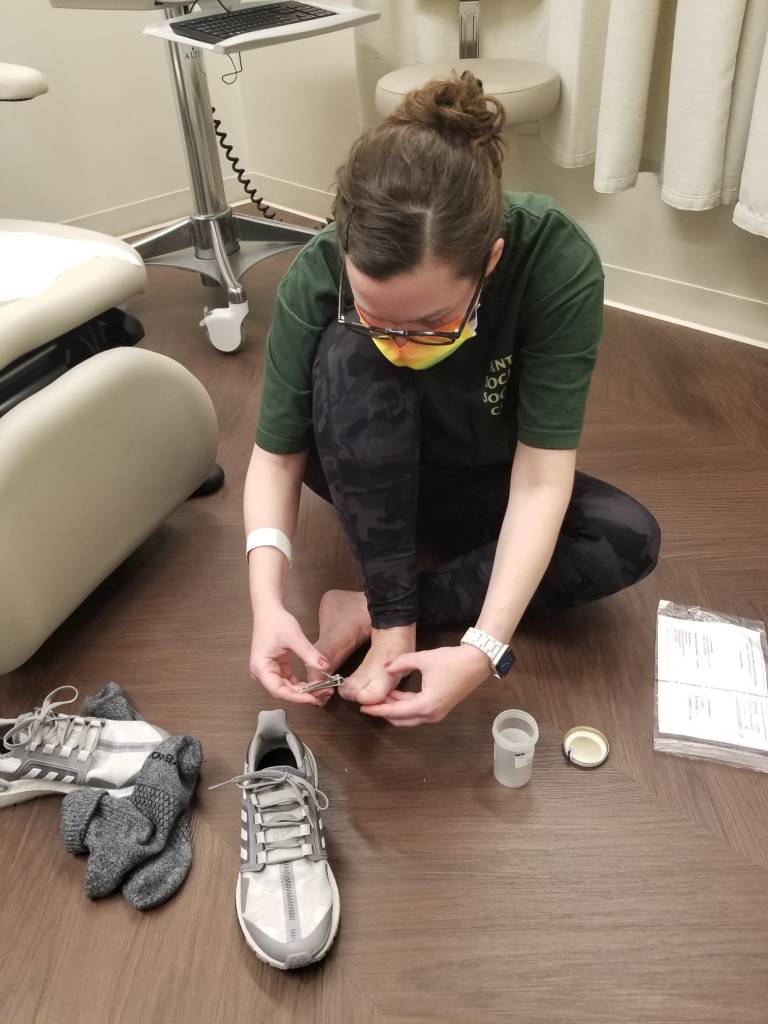
Cutting my toenails because our birth DNA information is in our nails?! Who knew? Definitely not me, as I had nail polish on my fingers and had just trimmed my toes very short a couple days ago. I asked if they had nail polish remover and they were like, “No, sorry, we’ve been trying to get that.” Despite their sophisticated Koch brother resources, MSK is not capable to go down to the corner store. It was a bit ridiculous as I struggled to collect the mandatory 10 slivers of nail without hurting myself while Javi oversaw the process, “that’s a dust particle not a nail.”
The final medical person to visit me was a researcher. I consented to be in a few studies and gave them my nail scraps. I got the sense I was a high-value specimen from the way Dr. Goldberg had spoken about things.
We got back home by 1pm. I felt tired from the anticipation/nerves wearing off, somewhat depressed, and irritable, so I was grateful I had the whole day off. I had known and remarked multiple times that it was very likely I would not get more answers at this first appointment. But the actual knowledge of that and the need to wait at least a month for anything more felt frustrating.
On Friday, I got up and went to my office like usual. Mid-morning I picked up a call from a number I thought was Dr. Ullah’s cell phone (my referring hematologist). I was right, and he seemed kind of out of breath about a report he just got back from my BMB, which he emailed to me while on the phone.
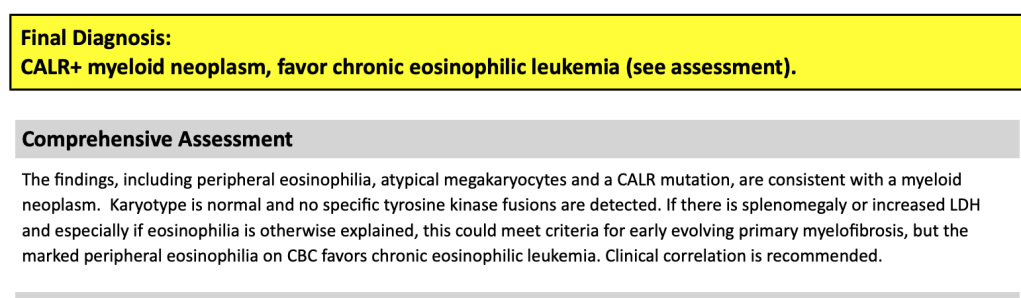
Apparently he had already spoken with “the head guy” at MSK (unclear if Dr. Mauro?) before calling me. Dr. Ullah said I was “in good hands” and to follow up with MSK. I was pretty rattled by the unexpected information with a FINAL DIAGNOSIS and left work because my schedule was thankfully clear.
Through MSK’s robust patient portal, I sent a message to Dr. Goldberg asking how he felt about this report’s “favored” diagnosis. In the meantime during the afternoon, MSK scheduled me for my future cardiac tests (CAT, Echo, and EEG), the pulmonologist, and for my next in-person follow-up with Dr. Goldberg which will be on Monday, March 13. Also in the meantime, Javi rode his bike to Dr. Rafati’s office. She was my original hematologist in late 2019-early 2020 who completed/ordered many workups including a BMB to give me a diagnosis of “eosinophilia of undetermined significance.” My paper records there were stored away in the pandemic and difficult to access, but they were finally ready for pick-up.
Dr. Goldberg called me at 5:02pm which was impressive to us. He confirmed that we should wait for MSK to make a diagnosis and not run too far with the final diagnosis on this report. It’s kind of funny that a diagnosis of chronic eosinophilic leukemia would now be a positive thing to me, as compared to MF. He reiterated the uniqueness of my situation and said he was going to speak to Dr. Ullah and seek input from his team. Then I dropped a brand-new piece of info on him: Dr. Rafati’s records show on 12/12/19 she tested for MPN genetic markers including CALR, and all came back negative. His reaction confirmed this was a bit of a bombshell. If the tests are correct, that means my gene mutation happened between December 2019 and November 2022, after my eosinophilia first presented itself. My megakaryocytes were also typical in Dr. Rafati’s BMB. Javi said this is probably pretty useful information for the researchers and I think he’s right. To be continued, as to what it means for my case and diagnosis. It seems like it may elevate/increase attempts to rule out other causes for my eosinophilia.
I am working on accepting that from now on, my life is probably going to include a lot of tests, monitoring of my condition, and lack of clarity of what the future holds. I am satisfied with the quality of care I’m receiving and I know my case is being considered carefully. I feel optimistic and well-supported right now – and thank you for being a part of that.
 my blood matters
Leave a comment